
FST BLOG
Beyond Exploration: How the UK is Talking About Space as an Industry
- 1 June 2026
- Business, Technology
- Nic Conner

It was great to see the FST explore both the legacy and future direction of the UK’s space sector at a moment of major institutional change.
Against the backdrop of ongoing discussions around what government, industry and policymakers now need to do to strengthen the UK’s position in the global space economy, support innovation and investment, and ensure the sector can continue to grow competitively in the years ahead, we fired up our AI-powered public debate insights platform, to understand how space as an industry is being discussed in the public arena.
Rather than simply tracking discussion around space as a scientific or exploratory field, we looked at how the sector is being framed within wider conversations around industrial strategy, sovereign capability, defence resilience and national competitiveness.
We analysed not just whether coverage is positive or negative, but how themes such as investment, infrastructure, manufacturing, national security, launch capability and commercialisation are evolving across both the media and political landscape. The aim was to understand whether the UK space debate is shifting from one centred primarily on research and innovation towards one focused more heavily on strategic capability and economic value.
The first thing that stands out is that the conversation is being driven far more by policymakers than by the media. It is important to remember that we analysed space as an industry, not broader public fascination with space exploration or stories about life on Mars. In Parliament, much of the discussion is led by ministers through statements and formal responses, often designed to place government policy, actions and priorities on the parliamentary record.
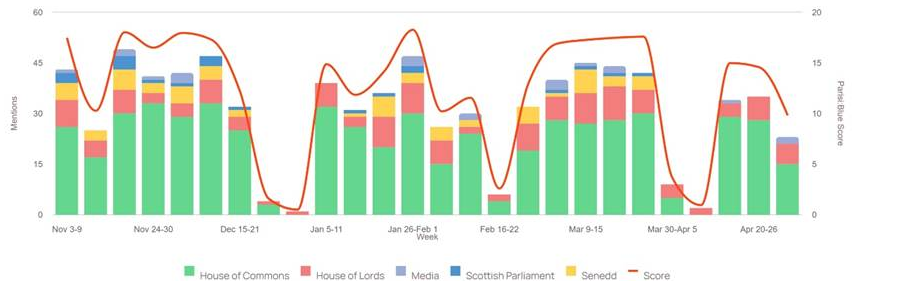
For example, the Prime Minister recently presented a written statement outlining the transfer of responsibility for severe space weather policy from the Department for Energy Security and Net Zero (DESNZ) to the Department for Science, Innovation and Technology (DSIT).
Unsurprisingly, Kanishka Narayan MP, a junior Minister in DSIT, has made the highest number of parliamentary contributions referencing the space sector over the past six months, with 46 mentions. These range from outlining plans to advance the sector through collaboration between DSIT and DBT, to identifying priority subsectors, accelerating scale-up investment and supporting trade missions such as the planned UK space trade delegation to Japan. He has also repeatedly highlighted that the UK captures around 5% of the global space market, leads Europe in private space investment and ranks third globally for private space company funding, reinforcing the government’s “One Government” approach to supporting the sector.
Across the media landscape, much of the coverage over the past six months has come from financial and technology publications reporting on investment activity, particularly around start-up funding. Publications such as UKTN have focused heavily on new investments by space focused funds including Seraphim Space.
However, when you rank content based on reach, publication importance, relevance and sentiment, the most influential coverage often comes from policy driven reporting. This includes stories around Scotland refreshing its national space strategy to strengthen its position as a leading European space hub, as well as reporting from the Daily Telegraph’s Science Correspondent, Cameron Henderson on the UK Space Agency monitoring the growing risks posed by orbital debris and falling space junk.
What becomes clear is that when you remove discussions around space in a science and exploration context and focus instead on the sector as an industry, much of the excitement and storytelling disappears. In both Parliament and the media, the conversation becomes highly transactional, focused on policy announcements, investment figures, GDP contribution or funding rounds.
There is a clear opportunity for the UK space sector to do more to communicate what it is actually building, how it is contributing to the global space economy and why that matters to everyday life.
While the UK is often effective at telling the story of space exploration, it has been less successful at telling the industrial story of space in the same way other science and technology sectors have managed to do.
Nic Conner is a Partner at Parisi where he uses the agency’s AI-powered public debate insights platform to analyse how political and media narratives are shaping debate across emerging sectors including technology, infrastructure, energy and advanced manufacturing.
Header image by NASA (via Unsplash)