EVENTS
The Foundation organises events on key topics in science, research, technology or innovation, bringing together parliamentarians, civil servants, industrialists, researchers, learned societies, charities and others. Those events focus in particular on areas where there are policy decisions needed, which in turn need to be informed by this wide range of inputs and viewpoints. Summary reports are prepared for all events, and these - along with presentation slides, videos of speakers and audio files - are available online after events.
From innovation to impact: the role of science and technology in economic growth

In this webinar, members of the FST Future Leaders programme will explore what it takes to move from innovation to impact. Where does the UK do well, and where do promising ideas get stuck? What roles do research, investment, skills, infrastructure, business and government play? And should we be thinking more broadly about how new technologies are adopted and spread across the economy?
Read MoreCommunicating science: how do we talk about what we do, and does it work?
- 2026
- Lecture
- Online
In this webinar, members of the FST Future Leaders programme will explore what effective science communication looks like, how we adapt what we say for different audiences, and how we know whether our communication is actually working.
Read MoreWhat does effective engagement between science and policy actually look like?

- 2026
- Lecture
- Online
In this first webinar in "FST Future Leaders: The Big Questions", our Future Leaders will explore how researchers, policymakers and others working across science and technology can build more meaningful relationships, communicate evidence effectively and understand the different pressures and perspectives that shape decision-making.
Read MoreCan we devolve more science and innovation spending?
- 2026
- Dinner, Discussion
- The Royal Society and Online
There is a growing debate about how the UK’s science and innovation funding is distributed, and whether giving cities and regions greater control over investment could help drive economic growth across the country.
Read MoreScience Diplomacy – Can we help the world align through science?

- 2026
- Debate, Discussion
- The Attlee Suite, House of Commons
Science diplomacy can be a tool and practice that strengthens relations between nations. In a fast-changing and often volatile world, how can scientific research and international relations align to promote national interests and international alliances? This event is held in collaboration with Sense About Science during Evidence Week 2026.
Read MoreIn conversation with Sir Ian Chapman, Chief Executive UKRI

- 2026
- Discussion
- The Khon Centre, The Royal Society and online
A format that was back by popular demand, this was an 'In Conversation' evening with Professor Sir Ian Chapman, Chief Executive of UKRI (UK Research and Innovation).
Read MoreInnovation in cities and regions of Scotland
- 2026
- Debate, Discussion
- University of Strathclyde and online
Through its National Innovation Strategy, the Scottish Government wants to create one of the most innovative small nations in the world, over the next decade. In this event, we will explore the role of innovation in growing the Scottish economy.
Read MoreUK Space Policy and Supporting UK Space Industry - Past, Present and Future

- 2026
- The Royal Society and online
The UK Space Agency (UKSA) was established on 1 April 2010 as an Executive Agency of Government. On 31 March 2026, UKSA ceases to be an Executive Agency and its functions are being absorbed into the Department for Science. Innovation and Technology, though it will retain its name. Meanwhile in November 2025, the House of Lords UK Engagement with Space Committee published its report The UK Space Economy: Act Now or Lose Out, with recommendations on the UK's strategy for space and growing the space economy. In this event we will both look back at the work of the UK Space Agency over the last 16 years, and look forward to what is needed now to support the UK space economy in 2026 and beyond.
Read MoreFrom publication to public action: the case for responsible science activism
- 2026
- The Royal Society and online
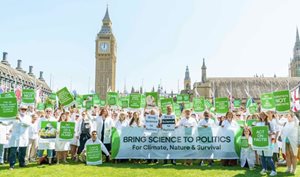
The scientific evidence for climate change, the harm it is currently causing and will cause in the near future, and the actions needed globally to avoid catastrophic levels of warming, are firmly established and globally accepted by the scientific community – and have been for more than two decades. Yet governments around the world are reducing net zero ambitions and reneging on longstanding international commitments. In this event, we want to explore whether there is a case for responsible science activism, where scientists speak out, to affirm the reality, gravity and urgency of the multiple challenges we face. And if there is a case for science activism, how should the science community, universities and other employers, and the science structures within government, respond.
Read MoreEnhancing the UK’s preparedness and resilience to climate change

- 2026
- The Royal Society and online
The impacts of climate change are already being felt in the UK, and we can see the costs of inaction on growth, security, and health. Coordinated climate adaptation action is needed now to ensure the resilience of the UK to increasing climate-related shocks. The Council for Science and Technology (CST), the government’s top-level advisory body on science and technology issues, wrote to the Prime Minister on 28th October 2025, providing advice on climate adaptation and resilience for the UK. In this event we will discuss priorities for climate adaptation action in the UK, the development of climate adaptation targets and will be an opportunity to dive deeper into CST’s four recommendations.
Read MoreOn this day...
Foundation held a debate: