
FST BLOG
Glaciers and Ice sheets in a Warming World
- 18 February 2026
- Environment
- Professor David J Drewry
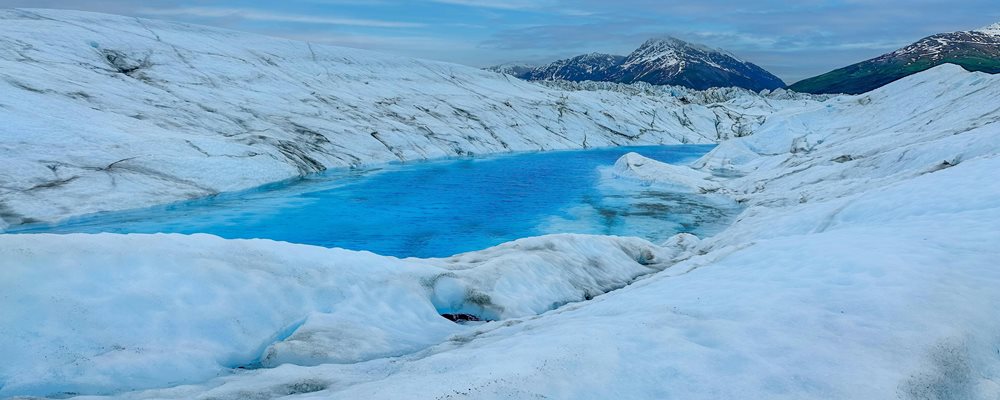
As I write this blog I am reflecting on a year of travel when I have visited glaciers in Patagonia, northern Norway and the European Alps, tracts of glacierised terrain in Svalbard, and ice caps in Iceland. The story from these wild and dramatic places is the same – shrinking glaciers and communities at risk. The high mountain regions of our planet are some of the most vulnerable to change.
Héctor Basilio Poma is 64 years-old and lives on the slopes of Tuni Condoriri in the Bolivian Andes, making ends meet by raising llamas. In recent years his work has become tenuous amid shrinking of local pastures. Basilio says Tarija Glacier has halved in size since he was a boy, cutting the water supply. “We’ve had to reduce the herd” says Basilio with great sadness.
This is one of countless stories that add to my own, less dramatic encounters, that tell directly of the circumstances experienced by inhabitants of the high mountains region as glaciers retreat with unrelenting atmospheric warming. Further afield the large ice sheets of the sparsely populated polar regions might appear to be of lesser concern. Here, however, there is a world-wide threat, increasing year by year. In the Arctic temperatures are rising at a rate faster than the global average by a factor of three. Ice caps and the Greenland Ice Sheet are responding with melting, feeding substantial quantities of fresh water into the world’s oceans. Greenland is losing ice (270 Gt per year), five times more than 20 years ago. In Antarctica, glaciers in the Antarctic Peninsula and the West Antarctic ice sheet are the fastest warming regions contributing to the collapse of some smaller ice shelves. The melting of the two great ice sheets combined (Greenland 22%, Antarctica 7%) with the contribution from mountain glaciers around the world (~15%), account for about 45% of the increase in mean global sea level.
Around the world communities living at or close to shorelines face a future threatened by ocean flooding. These people number many hundreds of millions, are on every inhabited continent and on many hundreds of small islands scatted across all oceans. Developed nations and least developed counties are equally exposed. By 2050 the additional rise in sea level is estimated to be about 170mm.
In response to these mounting pressures, the United Nations has identified some two billion people who rely in various ways on water from glaciers – domestic use, agriculture, industry and power generation. These waters are also crucial for sustaining the high montane biosphere. Taking action, the UN charged UNESCO and the World Meteorological Organisation (WMO) to initiate a programme: the 2025 International Year of Glaciers’ Preservation (IYGP) to assess and monitor changes in snow, glaciers, and water resources. 2025 also marked the launch of the Decade of Action for Cryospheric Sciences (2025–2034). This is, again, being coordinated by UNESCO.
Scientists in the United Kingdom have a long and significant engagement with glacier research. In discussion with UNESCO I agreed to engage with the community and seek contributions to a publication, supporting the IYGP, demonstrating their active research and raise awareness of the impacts of climate change on glaciers and mountain regions. Delighted by the response, I assembled fifteen contributions from some twenty scientists from 13 institutions – universities and research organisations both governmental and commercial. The outcome was the report, published in late 2025 by the UK National Commission for UNESCO[i].
Divided into four sections the articles emphasise the timely development and opportunities of UK research programmes for investigating glaciers around the world such as “Deplete and Retreat”, “Glacier Mass Balance and Intercomparison Exercise (GlaMBIE)” and “The Big Thaw”, the latter emphasising hydrological issues and concerns.
Today much information can be garnered using satellite systems, often the only way due to difficulties of access, obtaining synoptic data, and managing precious research budgets! Two papers examine the range of techniques for measuring the changing mass of glaciers from space and highlight dedicated cryosphere projects such as CryoSat and the forthcoming CRISTAL satellite mission. Utilising early archived photographs and even de-classified spy satellite imagery has also proved important and extended the timeline of cryosphere decline.
A substantial section on mountain glaciers examines the changes taking place and the impacts on river basins and montane communities. Several articles concentrate on the Andes as a whole or various regions such as the “tropical” sectors in Peru and Bolivia or the southern glaciated belts in Chile and Argentina. Here the contribution of meltwater to the water supply can be up to 80-90% particularly in extreme drought periods. Interdisciplinary studies and citizen science contributions emphasise the human dimensions and importance of glacier monitoring.
A final part examines changes to ice caps and ice sheets. Two articles focus on Greenland. In one there is an examination of the hazards created by increasing iceberg discharge into commercial sea lanes as the pace of Arctic development accelerates. The second seeks to understand the role of sub-glacial water bodies (lakes) in the dynamics of fast flowing outlet glaciers responding to climate forcing.
In Antarctica, as atmosphere and adjacent oceans warm, there is accelerating coastal retreat and un-anchoring of some of the floating fringe of ice shelves. Four articles address these issues and allied studies of ice sheet flow dynamics, increasingly influenced by surface melting and water drainage.
A concluding paper examines how an understanding and modelling of former ice sheets such as that over the British Isles can constrain and improve future predictions of ice masses to global warming.
[i] Glaciers and Ice Sheets in a Warming World: Impacts and Outcomes (UK National Commission for UNESCO, 2025) is available open access under Creative Commons BY-NC-SA 4.0 at www.unesco.org.uk.
Professor David Drewry is Honorary Fellow at Emmanuel College, Cambridge University from which he holds a Doctorate and where he was Director of the Scott Polar Research Institute. Between 2017 and 2025 he was Non-Executive Director at the UK Commission for UNESCO. Previously he was Director of the British Antarctic Survey, a Trustee of the Natural History Museum, London, President of the International Arctic Science Committee, and Vice-Chair of the European Universities Association. He served as a member of the UN’s Intergovernmental Panel on Climate Change. David has been awarded the Polar Medal, Patron’s Gold Medal of the Royal Geographical Society, and the Prix de la Belgica Gold Medal of the Royal Academy of Belgium. He has a mountain and a glacier named after him in Antarctica.
Photo of Alaskan glacier by Steven Crane via UnSplash.